Too Much to Swallow
As serious as a heart attack. Or a heartless one.

1
Greater Israel stretches from the Nile to the Euphrates.1 That comprises eastern Egypt, northern Saudi Arabia, Jordan, Lebanon, most of Syria, southern Iraq, a sliver of Turkey, and northern Kuwait. And of course all of Palestine, where luckily nobody lives except some Arabs. But I repeat myself. Consider them squatters. Israel holds the deed in an old book written by Israelis, or rather Palestinians, since Israelis are largely European, and of questionable descent. Eh, technicalities. Kick them out.

You could say Greater Israel runs from the rivers, plural, to the seas, plural, since it borders not only the Mediterranean but also the Red Sea and Persian Gulf. For comparison, that’s bigger than Turkey, a lot bigger than France, roughly the size of three Germanys, though some say one is quite enough, and twice the size of Ukraine, but check back on that later, since the figure keeps changing.
Why stop there? Suppose Israel stakes a claim to the homeland of the Khazars, from whom they’re definitely not descended, which doesn’t mean that land isn’t theirs too. As a pithy ideological summary of Theodor Herzl, an atheist founder of Zionism, goes: “There is no God, and He gave us this land.” That means Azerbaijan, Armenia, Georgia, basically the Caucasus between the Black and Caspian seas, plus a chunk of Ukraine, or Russia, whatever.
Of course so far I’m referring only to physical, albeit absentee, ownership, since Israel hasn’t taken possession of its full property portfolio, yet. Consider other assets, tangible and intangible, that flow like milk and honey through hearts and minds, not to mention secret accounts of public officials and think tanks and public relations firms and media conglomerates, all over the world, winning friends and influencing people, and if that doesn’t do the trick, presenting them with surprisingly detailed dossiers, not omitting images and transcripts. If that’s to no avail, no hard feelings. To show we’re friends, here’s a free pager.
2
Let’s put on our sociopathy thinking caps, shall we?
Suppose I’m in the Israel First camp and my goal is to draw the U.S. into a glue-trap-sticky war. Preferably while profiting. I might look for a way to use a Foxed-up proxy close to the administration, maybe a K Street general like Keane or Kellogg, to talk up seizure of a Kharg Island. When blood spills, as it would by the barrel, and Fox World doubles-down with no-reverse-gear shrieking, count on it to be cheer-led and force-fed by the same K Street “experts” and media shills. The coverage will be like imaginary voices inside a psychotic head, except we can all hear them by tuning in to Fox, and predisposed regular viewers may actually believe what they’re saying, a certain occupant of the Oval Office prominent among them. It’s a self-fanning shite storm. Nor would I turn up my nose at false flags. You can fool some of the people all of the time.
This is a world that is the case.
3
Puzzlingly, some find that problematic.
4
May I offer a suggestion? Democrats! Republicans! Wait, let me start over. Republicans! Democrats! Join the Otherwise Party!2
Say what? Imagine an OP as an entirely virtual overlay of the existing structures. Its only mandatory Venn intersection: no funding from the Israel lobby. A Democrat can run on Democrat things; a Republican can do likewise as a Republican. Apart from the Israel lobby commitment, those who join it remain conventional D’s and R’s. No third-party ballot access rigamarole. No platform fights. Just a minimalist, focused political intervention. Want to hear out pro-Is people? No problem. But no Benjamins.
The logic goes like this: Israel can act as it does because of U.S. backing; U.S. backing is (partly) a function of lobby money. Ergo, cut the Gordian knot. That must happen at the level of party funding. Only then would it become politically possible to tell Israel no more money, no more weapons, no more trade, no more energy, no more political cover, no more hasbara, no more nothing if it doesn’t stand down—and submit its nuclear arsenal to inspections and reductions, for good measure. (Hey, some latitude here, it’s a thought experiment.) Eisenhower had his Suez. The political class could make this its Hormuz.
Will it happen? The probability is … low.
Could it happen? It’s like a game theory scenario in which neither side will risk turning on a third-party ally of both for fear the other will benefit. However if both sides see the ally as a threat, it’s imaginable that they might agree to neutralize it by cooperative action. In other words it’s a coordination problem. That also means it’s fraught with issues of trust, verification, defection, and cheating. So it’s not, if you’ll permit a redolent phrase from another manufactured crisis, a slam dunk.
But a strategy of focused cooperation isn’t inconceivable either. If markets tank and inflation goes vertical, incentives may align to make it look kinda attractive. Risky, to be sure, but with upside not just for the national interest, notional as that may be, but more saliently for popularity with voters and power within parties. What’s unknown is how ready players already are, and whether the game would proceed stepwise or by leap.
Before riding off on this pony, let’s acknowledge the likelier bet (for specie), if not ultimately the safer one (for the species), is on an old warhorse named Nash Equilibrium.3 It has the pole position. But some may be quietly saying that for this race it’s looking more than a little long in the tooth. Not much of a gift, that, and one that goes on taking to boot.
5
While what-iffing, suppose Iran announces that after a second unprovoked attack amid negotiations, it has reluctantly concluded that it has been left with no alternative but to acquire nuclear weapons. Because of that it has further enriched its uranium stockpile and now possesses 12 nuclear warheads that have been mounted onto missiles dispersed across multiple locations. To demonstrate that it isn’t bluffing, it invites a team of experts to visit a single site and verify the claim about its capabilities. However it is willing to reenter negotiations to discuss a regional security arrangement and suggests neutral states as intermediaries.
Is it likelier that this scenario would lead to a stand-down or escalation?
Taking the he-thinks-she-thinks a step further: Suppose the U.S. and Israel believe acquisition of nuclear arms will be Iran’s next move. They may be tempted to preempt that by nuclear escalation. But if massive, precise conventional retaliation by Iran can wreck the Gulf and Israel by targeting vulnerable infrastructure, the U.S. and Israel, with the exception of the most eschatologically driven, of which there are apparently quite a few, may be unwilling to take that step. It might be suicidal for Israel and irreparably damaging to the U.S., which may then be seen as a truly rogue state that others must collectively act to restrain.
Ironically, acquisition of nuclear weapons might be a way to defuse the crisis, albeit at cost of proliferation, and maybe worse, perverse incentives for other states to take the lesson that only nuclear arms can protect them.
Yet there could be a silver lining. Iranian proliferation could conceivably, if paradoxically, concentrate some minds on the desirability of arms agreements. They’re not panaceas, but what may be lost in a focus on technical details like warhead numbers or the enforceability of treaties could be the value, incalculable in times of crisis, of protocols and channels of communication that engender some degree of trust, confidence, and cooperation. Accidents are inevitable. Wouldn’t we want all the tools available to keep them from being fatal?4
6
Back in the real, or “real,” world, I learned today that there is a skin care business with the name Vichy. I mean, how apt is it to name a company after a government famous for saving its skin?
I mention this because I am coming to see most European states, and let’s not forget the EU, as attractions in a veritable Vichy theme park. I’m as susceptible to nostalgia as the next marginally anonymous literary onanist (well, maybe not quite as much), but sheesh, isn’t there a limit?
Jeffrey Sachs, whom Britain and the U.S. blocked from addressing the Security Council, approached the Danish UN ambassador after her Iran tirade that, oopsie, forget to mention Iran was kinda, you know, sneak-attacked by the U.S. and Israel? She gave him a feral look, turned on her heels, and marched off, clip-clop, clip-clop. Maybe they should rename it the Golding Room.
It will be just like that with the Gulf monarchies. It’s all Iran’s fault. Yesterday I heard Norman Finkelstein quote (loosely, it seems) Mark Twain: “After God created sheep He realized that humans were superfluous.”
It’s hard not to see the economic damage, which sadly will affect the global majority as well, as blowback from the Gaza genocide. Europeans didn’t speak out against Israel and the U.S.—some assisted them—which led those goodly gentlemen and ladies to conclude that a war against Iran would meet no opposition but silence and fidgeting. Indeed, the Euros went that one better. They issued condemnations of Iran. Vichy may be too kind.
7
And now, for the curious, another bulletin from the lofty realm of international politics: statements by the Chinese and Russians about the UN resolution condemning Iran, with no mention of why Iran would stoop so low as to launch attacks on its just-minding-their-own-business neighbors.
Recently I read Hua Bin on how China sees the crisis. And I get that there may be “nuances” to explain choosing abstention over a veto, as in the vote over administration of Gaza. And yet … doesn’t this violate a first principle of bullyology? (I mean actual bullyology, not the ersatz projected version peddled about the conflict between Russia and Ukraine.) That principle being, a bully only stops when stopped. That’s because a bully understands ingratiation, compliance, or even rational discourse as weakness, which leads to further aggression, much as running from a dog cues chasing.
I know that the bulk of what’s really going on goes on well out of sight. I understand the importance of biding time and the avoidance of polarization. Perhaps there’s downside with little practically constructive in a vote of no. And a yes vote won’t in itself neutralize what’s corroding any semblance of fairness or impartiality, an intangible basis for collective security that the Security Council might regret the loss of. And if that isn’t enough, we’re told members voted against Iran to play up to the Gulf states (remember us when you dispense the Spice!) and the U.S. (please don’t bomb, sanction, or tariff us!), and besides, no one likes Iran anyway (for … reasons). Plus, Chomsky-deranged Occidentals place an unhealthy emphasis on meaningless speech acts (shut up and trust the plan!).
I’m reminded of Putin’s chuckle when Tucker Carlson asked him about the Nord-Stream sabotage: “If you had evidence and presumably, given your security services, your intel services, you would, that NATO, the US, CIA, the West did this, why wouldn’t you present it and win a propaganda victory?” Putin answered: “In the war of propaganda it is very difficult to defeat the United States because the United States controls all the world’s media.”
So, well, anyway, maybe it’s best to follow Louis’s advice and leave worries on the doorstep. Or Joe’s, and organize, if only a few thoughts, and move along, having seen what there’s to see.
8
About seeing: between 1810 and 1814, Francisco Goya composed images for what would come to be known as Disasters of War, published in 1863, 35 years after his death. He captioned each of the prints with a short line in quotation marks.5
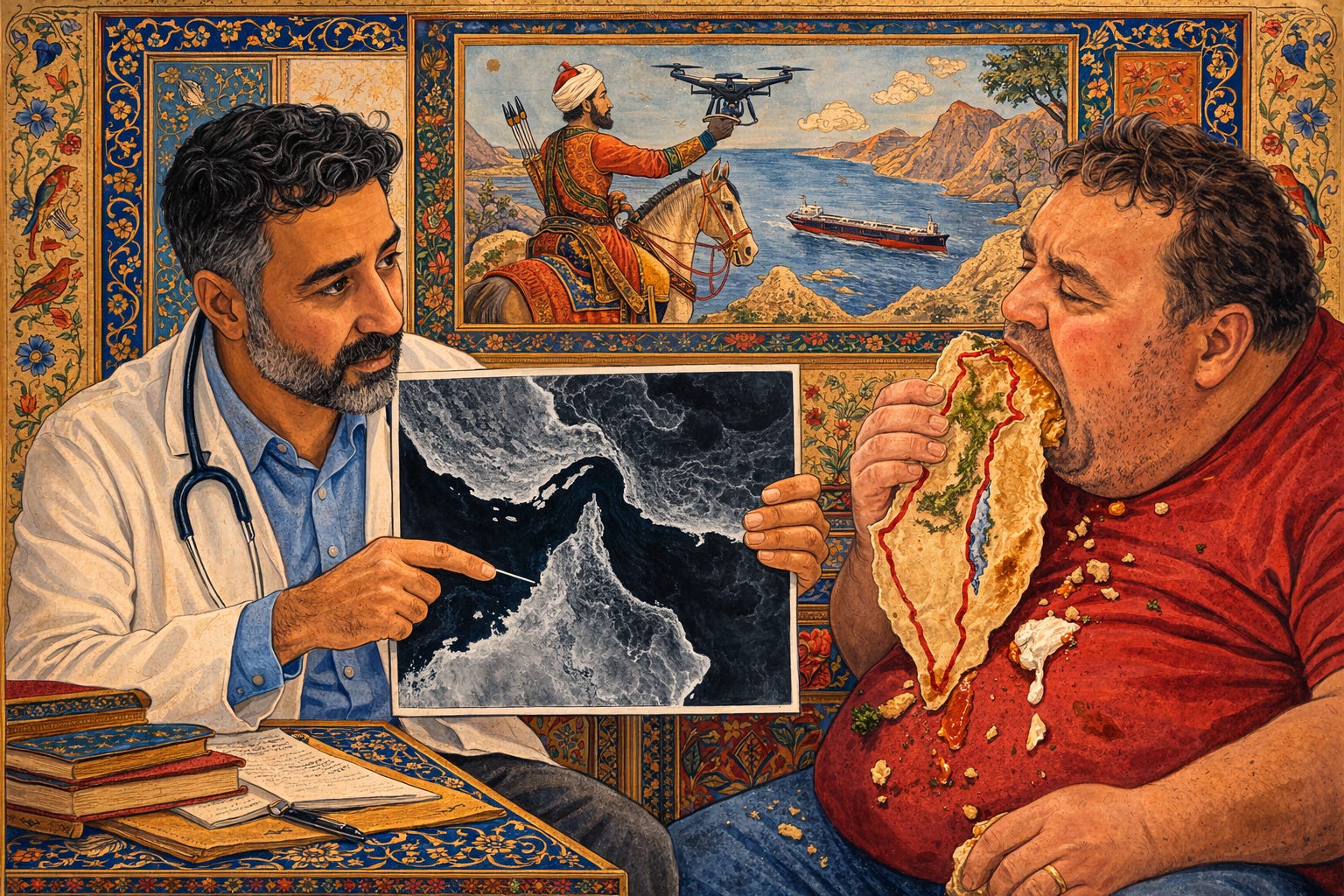
Oddly, it looks like a squirt of ketchup on a pita. Which came first I do not profess to know.
A source chat on the theme of the OP veers into discussion of the Sachs-Mearsheimer debate, among other things. Before you chide me for conversing mainly with imaginary friends, think of Machiavelli donning robes to enter his study and join the ancients.
By comparison, the Otherwise Party concept encapsulated in a clip, with the blonde as Israel (h/t Kouros, a commenter from Naked Capitalism).
Lunatics and AI, which in simulations escalates to nuclear war a lot, are bad enough. To really make your day throw in close calls. Then consider that in 72 minutes the world can effectively end. If curious, or masochistic, you can over-the-shoulder an AI conversation on the topic of this section.
For an extended close reading of Disasters, you could do worse than to flip through The Art of Witnessing, by Michael Iarocci.
As for “He likes it,” I would be remiss not to jiggle Boomer neurons with an atavistic cereal ad. Children grow up. Things change. Not always for the better.
Outstanding writing. I don't know how many orders of magnitude my ability to write is below yours. I suspect that I am not even qualified to give proper praise.
The problem of game theory, and AI in that regard, is that both technologies try to analyze the problems assuming the involved parties are logical, reasonable, will consider long-term consequences, etc., and at least try to maximize the welfare of at least one party. That is not what I have learned from human society. I found that most people are not quite logical, are concerned about "faces" more than long-term benefits, and sometimes have a self-destruction tendency. And if you add religious fanatics into the possibilities, quite often the problems cannot be resolved properly. Instead, the only viable solution is to make the problem "go away". Or to remove oneself from the scene, and let other people handle it. Or, to smash "the problem" such that people unrelated to "the problem" can manage to survive, somehow.
Jeff Sachs should have praised how wonderfully bold and righteous Nelson was to have Copenhagened the Danes...